


This page is about conversions of hybrids to plug-in hybrids (CalCars' original focus).
For conversions of internal combustion engines to plug-in hybrids and all-electric (CalCars' focus with "The Big Fix"), see All about Gas-Guzzler Conversions.
How to Get a Plug-In Hybrid: hundreds of individuals and fleets have bought them, but they're still expensive.
HERE'S THE QUICK SUMMARY:
Depending on the choice of battery types, PHEV conversions using lead-acid, nickel-metal and lithium chemistries are now available for $2-$13,000. Conversions are mostly for the second-generation (2004-2009) Prius. At these prices, people are buying the "environmental feature" -- they want to be among the first owners of the world's cleanest extended-range vehicles. They are early adopters, buying "Version 1.0" PHEVs with "Good Enough to Get Started" batteries. See Where PHEVs Are for a list of early conversions.
Tax Credits MAY BE Available: The Internal Revenue Service is developing rules for the 10% (to $4,000) tax credits for conversions put in service after February 2009, summarized at Vehicle Credits. The instructions for the required form 8910 remain a year old; we expect they will involve qualifications. A conversion company may say its products are eligible, but we haven't yet heard of any customers getting credits.
In addition to soon seeing "from the ground-up" PHEVs like the Chevy Volt, Fisker Karma, and others, we believe carmakers, benefiting from economies of scale and far larger development resources, will some day extend their current hybrid lines with far better PHEVs, and we think they will be able to sell them for several thousand dollars more than standard hybrids. At that point, we expect the aftermarket companies' prices to have come down sufficiently so that their conversions will be attractive to owners of hundreds of thousands of hybrids already on the road. And at that point, we expect these companies to move into conversions not just of hybrids but of non-hybrid gas-guzzlers (HEVT's F-150 below is a first prototype).
The nonprofit CalCars does occasional conversions to demonstrate new designs and provide a platform for different batteries; we don't sell conversions. We have sponsored the EAA-PHEV project and our Open-Source designs are being used by some of the private companies as well as technically advanced individuals.
See Below for Links to the Companies Offering Conversions
Though carmakers now speak positively of PHEVs, you won't find them at your local dealership until 2011. See How Carmakers are Responding to the Plug-In Hybrid Opportunity. If you want one now, know that you'll spend far more than they'll cost when mass-produced. Today you'd do it to be one of the first to drive the world's cleanest extended range vehicle; in the future, you'll do it because it's an obvious and affordable win!
CalCars supports conversion programs as a strategy to increase awareness and support for PHEVs and thereby motivate automakers to build production PHEVs. Though costs are now high, we believe automakers could sell PHEVs for only $2,000-$5,000 more than current hybrids.
Conversions are limited to certain vehicle types. So far, most start as hybrids. The easiest conversions are for 2004-2009 Prius (one company converts 2001-2003 Prius) and the Ford Escape/Mercury Mariner Hybrid. Because of Honda's different architecture (the engine runs whenever the motor runs), aftermarket conversion of Hondas are unlikely. (Both Toyota and Ford are now producing a few prototype conversions of their own Priuses and Escapes for research purposes.)
A new trend is conversion of internal combustion engine vehicles. For CalCars, these conversions are an objective on their own rather than primarily a strategy to build awareness and support for mass production of new plug-in vehicles. See Conversions to Electrify World's 900+ Million Cars.
As for warranties, there is legal precedent that original auto warranties cannot be voided completely by modifications — only the part(s) affected by retrofit will have their warranties affected. Typically, hybrid cars have four or five separate warranties. Car companies could decide that conversions void some or part of the hybrid system warrantyunless they worry that will tarnish its green image. Drivers of converted cars have received high levels of cooperation from dealer service departments so far. We agree with Toyota's comments, which is why we advocate for mass production of PHEVs:
"We're immensely gratified that some enthusiasts, in a tacit endorsement of the hybrid concept, are, on a vehicle-by-vehicle basis, converting Toyota hybrids to plug-in technology. But doing one-by-one conversions is a different kettle of volts from making this technology viable for the sale of hundreds of thousands of cars, at an affordable price, with a reasonable reliability expectations and reasonable warranty, serviceable at any Toyota dealer anywhere." -- Irv Miller, Toyota Motor Sales Group Vice President - Corporate Communications (Toyota Open Road Blog).
See also Hymotion's comments on the subject.
One Block Off the Grid www.Cars.1BOG.org, San Francisco, CA has organized the first ever group discount for Toyota Prius conversions. It's contracted with GreenGears for $1,000 off the installation price of the crash-tested Hymotion retrofit.
Aftermarket Conversion Sources
Advanced Do It Yourself/EAA-PHEV www.priusplus.org: CalCars and the Electric Auto Association's PHEV group created this open-source project to bring PHEV conversions to '04-09 Prius owners across the country. Our goal is to enable owners to enlist a local electrician/engineer to convert their cars, initially with lead-acid batteries, for under $6,000 and less than two person-weeks of time. If you're an engineer or an advanced do-it-yourselfer who is comfortable around high voltage batteries and automotive workshops, you can join the discussion and the project!
3Prong Power www.3prongpower.com, Berkeley, CA sells complete lithium battery systems including installation at $3,499 and up for the 2001-2010 Prius as well as the Ford Escape Hybrid.
Amberjac Systems www.amberjacprojects.com United Kingdom-based company has provided conversions in Europe. For Germany, Netherlands, Belgium and other Northern European countries, contact TTD in Delft, Holland.
EETrex www.eetrex.com (Energy Efficient Transportation Technologies, formerly Hybrids-Plus) Boulder, CO offers lithium-ion conversions of the Toyota Prius and the Escape, for private individuals or for organizations.
Enginer www.enginer.us sells complete 2kWh and 4kWh lithium battery systems for $1,995 and $3,495 ($1,000 more in CA with a 5-year warranty). This lowest-priced of all conversion options uniquely can be installed in Generation 1 (pre-2004) Priuses as well. Enginer has installer partners and offers do-it-yourself instructions. The Michigan-based company is a consortium between AutomationTech Inc, USA and Australia-owned Enginer Environmentech Ltd., China.
Hybrid Electric Vehicle Technologies www.hevt.com Chicago, IL converts Ford F-150 pickup trucks. The company has one prototype and is seeking fleet and early adopter buyers for the first few dozen conversions at $50,000 (customer provides truck). Its goal is large-volume conversions at $10,000.
Hymotion www.hymotion.com Watertown, MA
retrofits the Toyota Prius. Acquired by battery maker A123 Systems www.a123systems.com. Crash-tested
Prius conversions can now be ordered for $10,395 from distributors in several cities.
Green Gears, Inc. is Hymotion's San Francisco-based distributor/installer.
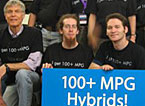
CalCars converted Priuses into a PRIUS+ at the 2006 and 2007 Maker Faires. This formed the basis for the EAA-PHEV project.
Plug In Supply www.pluginsupply.com, San Rafael, CA, sells conversions for the Prius with 10 kwhr useable energy for $11,995. EV-only driving over 50MPH, with a restart required to go faster. Professional installation available from approved installers. Check for products for other hybrids. Components and assemblies are also available for "do-it-yourselfers" and battery packs for converting internal combustion engine vehicles to EVs.
Other Companies You May Have Heard About NOT Offering Conversions
EDrive Systems, LLC www.edrivesystems.com emerged from the original EnergyCS (see below)
EnergyCS www.energycs.com Monrovia, CA. EnergyCS assisted in CalCars' first conversion, became the first after-market conversion company, and provided the first system in Felix Kramer's Prius; currently provides vehicle integration and battery management system designs to corporate customers including Nissan.
OEMtek www.oemtek.com: Milpitas, CA, built several prototypes but has no product available.
Other Conversion Projects
CalCars Demonstration Conversions CalCars has helped get started and worked with many of the companies listed above. CalCars is continuing to evaluate new batteries of different types and give battery companies a platform to demonstrate their products.
Hybrid Center at the University of California-Davis: under Prof. Andy Frank, this academic program has converted a number of internal combustion engine vehicles for demonstration purposes. Frank has formed Efficient Drivetrains, Inc. to put his intellectual property to work with carmakers and suppliers.
PITCH: If you support our goals, you could support CalCars with a tax-deductible donation in any amount by credit card, check, PayPal or Google Checkout. $25 or more gets you a bumper sticker. For $95 you become a Charter Sponsor. Gifts in the three figures are highly appreciated. Donations in the four-to-five figures will get you a phone call from CalCars' Founder Felix Kramer or Technology Lead Ron Gremban and, schedules permitting, a ride in a plug-in hybrid.
